Comprehensive BIM Services For Smarter Design And Construction
Explore our full range of BIM services and discover how we can optimize your projects, save your time and streamline collaboration.
Scan-to-BIM & Digital Twinning
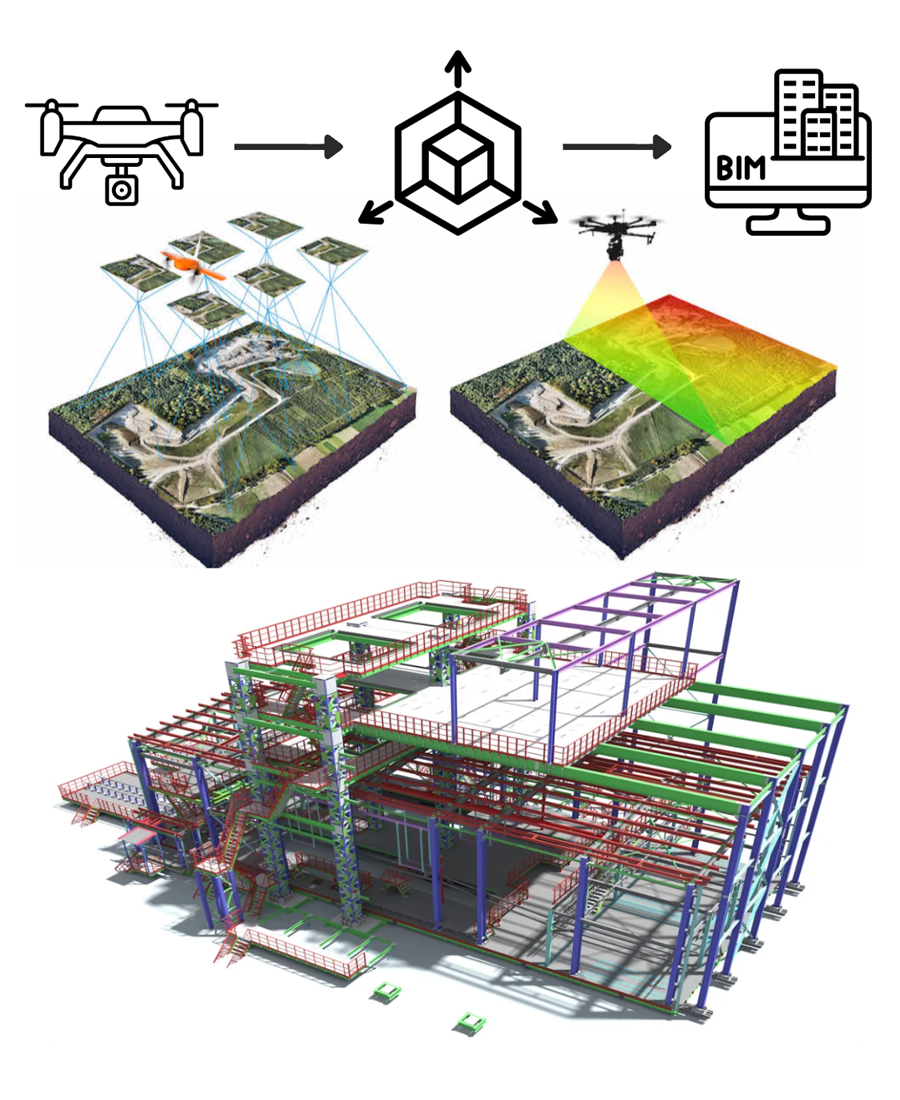
Drone LiDAR & Photogrammetry Capture
Aerial and ground-based data capture using drone-mounted LiDAR and high-resolution photogrammetry for sites, facilities, and infrastructure.
Reality Capture & Point Cloud Processing
Registration, cleanup, and classification of multi-scan point cloud data, delivered in RCP, E57, LAS/LAZ, or other formats to suit your workflow.
Scan-to-BIM Modelling
Rebuild architectural, structural, and MEP elements from scan data to required LOD, with deviation analysis against design intent.
Digital Twin Development
Connect captured geometry and asset data into living, browser-accessible digital twins for ongoing facility management.
Site Monitoring & As-Built Verification
Recurring capture for progress tracking, volumetric analysis, and tolerance verification throughout construction.
Model Management
Multi-Discipline Creation
Create and develop architectural, structural, or MEP BIM models to required LOD (100–400+) tailored to each project stage.
Optimization & Hygiene
Maintain clean, optimized models with best-practice workflows to ensure performance and reduce file size.
Lifecycle Updates
Continuously update the model throughout design phases, from concept through detailed design to IFC delivery.
Standards Compliance
Align models strictly to BIM standards, shared parameters, and naming conventions for consistency.
Cloud & Collaboration
Prepare models for ACC/BIM360 or BIMcollab with managed links, worksharing, and rigorous version control.
Analysis & Simulation
Environmental & Climate Simulation
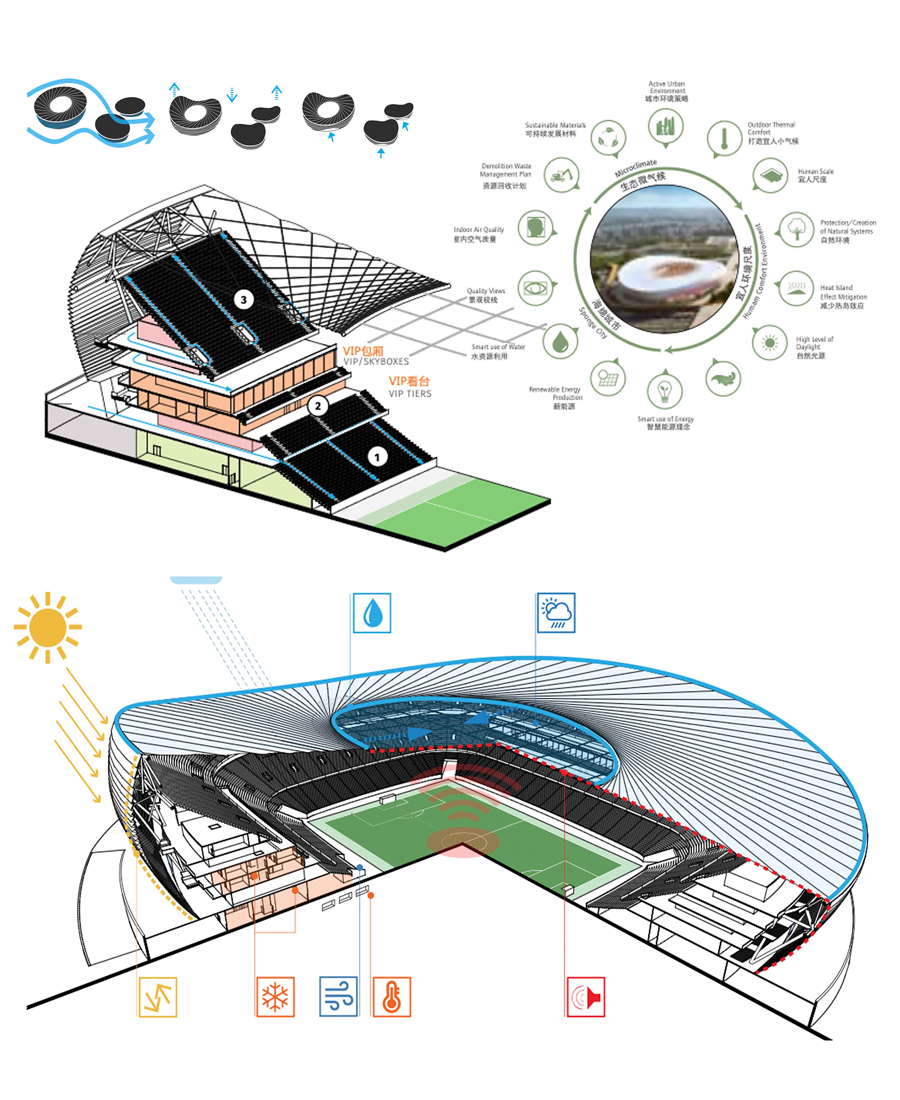
Assess natural light levels, glare, and solar exposure for design optimisation and heat transfer, wind comfort, and smoke movement for safety and comfort.
Urban Mapping
BIM/GIS integration to model precincts, infrastructure, mobility, and land‑use patterns for informed urban‑scale planning.
Building Performance & Sustainability Analysis
Help engineers to evaluates energy use, thermal comfort, and sustainability impacts using BIM data.
Analytical Surfaces
Prepare 3D analytical surfaces for sustainability design criteria mapping and detailed environmental analysis.
Reporting & Visualisation
Uses scripts and APIs to run repeatable analysis scenarios efficiently and deliver dashboards, charts, and animations to communicate outcomes clearly.
Detailed Modelling & Complex Scripting
Parametric & Scripted Design
Rule-based modelling using Dynamo / Grasshopper to create complex geometry and custom parametric components efficiently.
High-Detail Assemblies
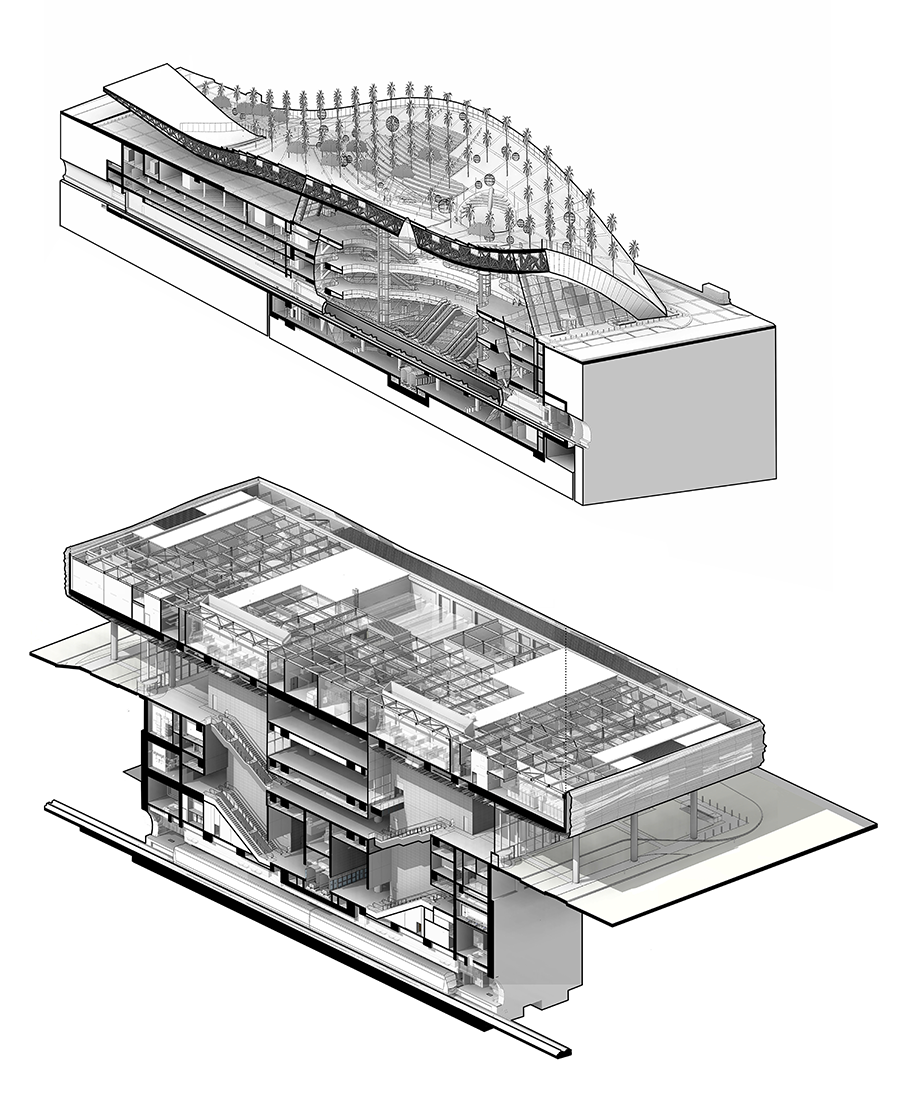
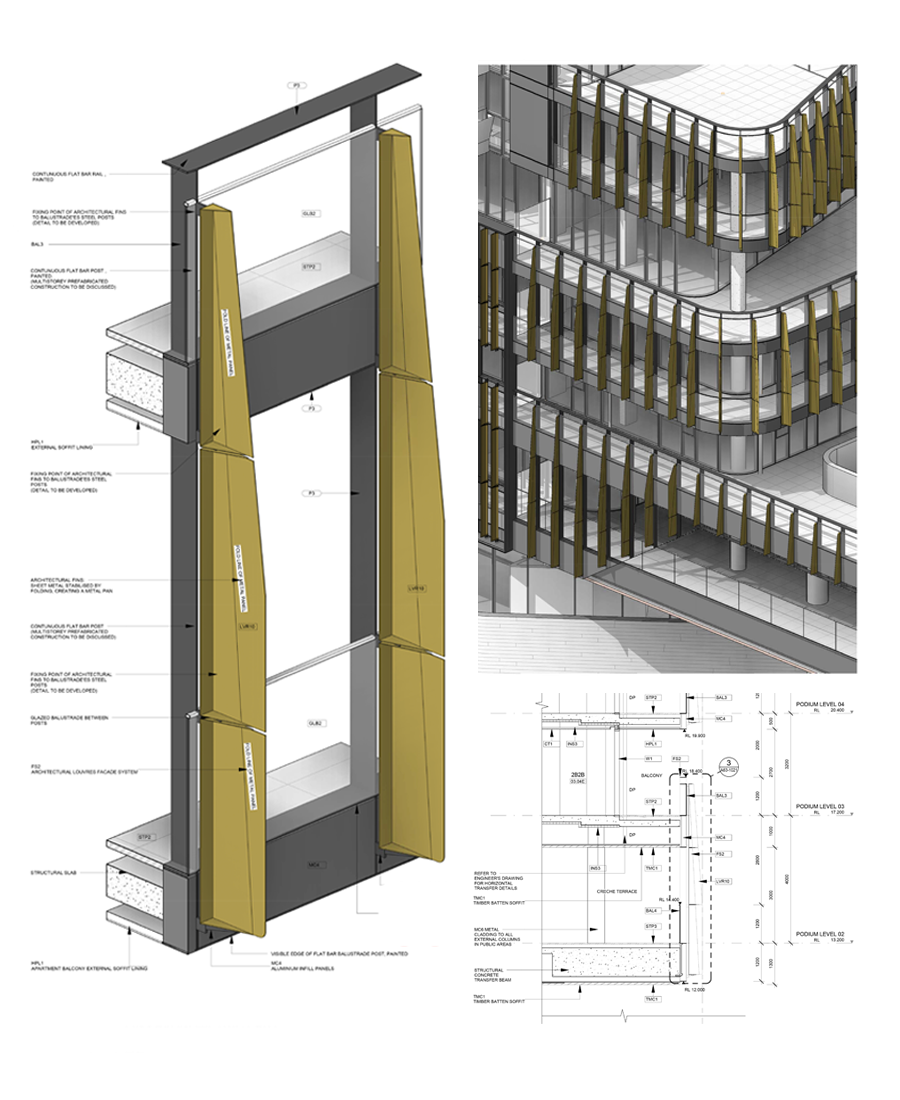
Develop high-detail assemblies including complex façades, bespoke joinery, stairs, and precise MEP routing systems.
Coordination Readiness
Prepare models for federation by cleaning warnings, resolving errors, and optimizing performance for clash detection.
API Integrations
Bi‑directional data sync across ACC/BIM 360, Aconex, ProjectWise, SharePoint, and Teams, with custom property sets, openBIM mapping, and automated BCF issue posting.
Design Optioneering
Manage design options for client review with integrated issue tracking and structured change management.
Documentation Production & Schedules
Comprehensive Packages
Prepare complete documentation sets for DDP, SD, DD, CD, IFC, or tender packages tailored to project requirements.
Views & 3D Documentation
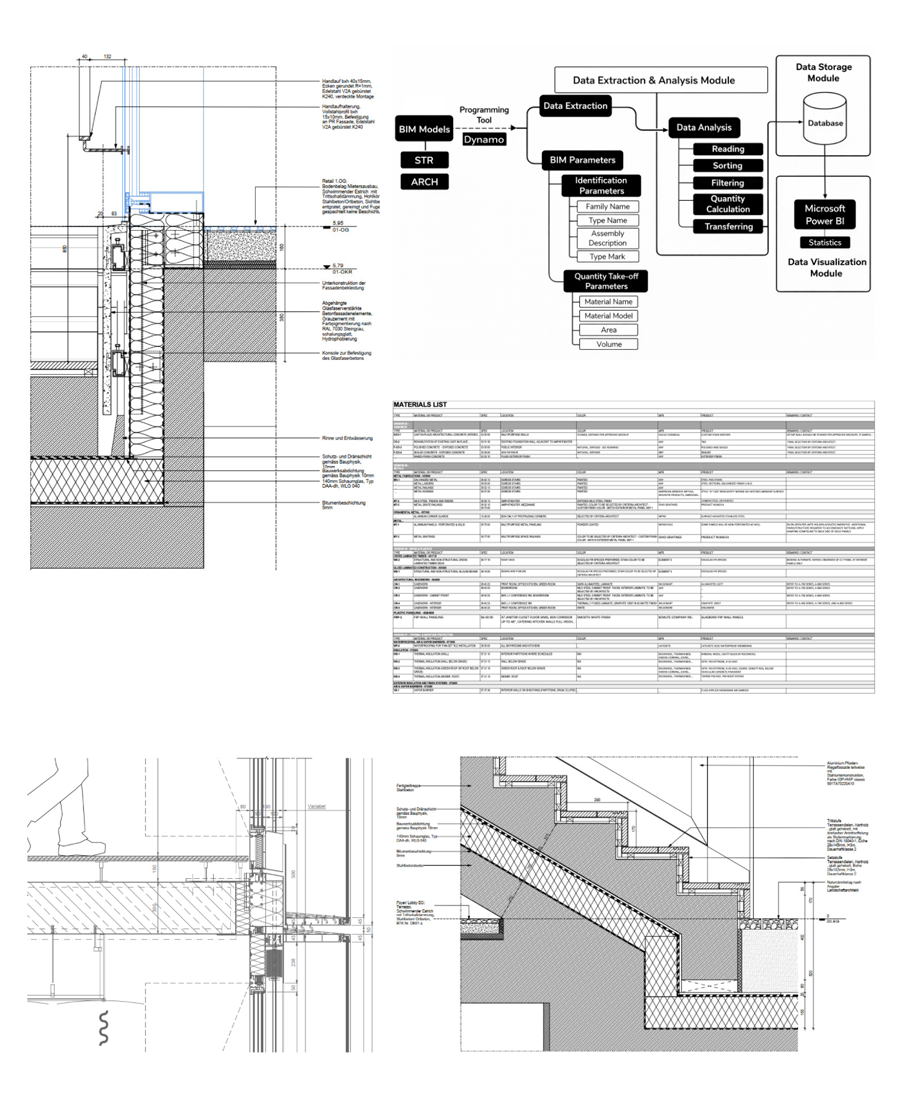
Produce plans, sections, elevations, and 3D documentation utilizing standardized view templates for clarity.
Sheet Management
Create and organize sheet sets, title blocks, and drawing indexes to ensure organized deliverables.
Data-Rich Schedules
Develop automated schedules for room data, quantities, doors, and finishes for consistency and speed.
Graphic Optimization
Manage external links and worksets effectively to produce optimal graphics for high-quality design documentation.
Detailing & Quantity Takeoff
Comprehensive Packages
Prepare complete documentation sets for DDP, SD, DD, CD, IFC, or tender packages tailored to project requirements.
Views & 3D Documentation
Produce plans, sections, elevations, and 3D documentation utilizing standardized view templates for clarity.
Sheet Management
Create and organize sheet sets, title blocks, and drawing indexes to ensure organized deliverables.
Data-Rich Schedules
Develop automated schedules for room data, quantities, doors, and finishes for consistency and speed.
Graphic Optimization
Manage external links and worksets effectively to produce optimal graphics for high-quality design documentation.
Data-Center Design and Modelling
Masterplanning and Whitespace Design
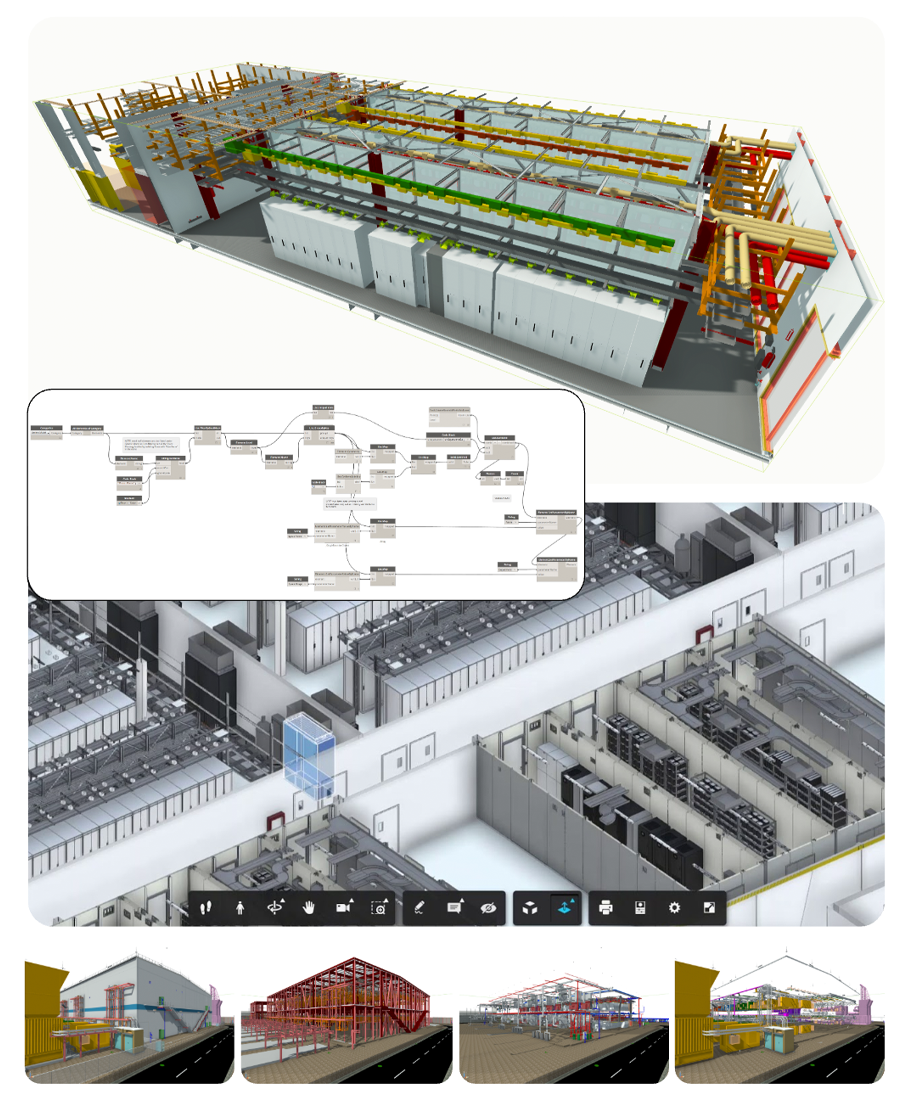
Site masterplanning and interior server hall configurations designed to maximize rack density, cable routing efficiency, and operational scalability.
Advanced MEP Clash Detection
Resolve complex spatial conflicts between critical mechanical, electrical, and plumbing systems to guarantee flawless constructability.
Permit Documentation and Calculation Support
Extracting highly accurate 2D permit drawings, schedules, and engineering quantities directly from coordinated 3D models to support permit application.
Modular Scalability Modeling
Developing standardized, precise component families for the rapid, repeatable modeling of server halls and power blocks.
Lifecycle Facility Management
Digital twins embedded with comprehensive asset data, empowering your clients to streamline ongoing maintenance and track equipment seamlessly.
Construction & Delivery
4D Model and Construction Sequence
Assign construction sequences and logical dependencies with optimised task order to reflect planned build order and minimise project duration.
Schedule Optimization and Progress Tracking
Reduce construction risk. Monitor planned versus actual progress to identify delays, bottlenecks, or deviations from the intended schedule.
Coordination & Issue Management
Continuously update the model throughout design phases, from concept through detailed design to IFC delivery.
Trade Model Intake, Federation & Governance
Ingest, validate, and federate trade models to a single source of truth with robust version control.
Temporary Works & Site Safety Modelling
Model temporary works and simulate safety constraints to reduce incidents and rework.
PROCESS. COORDINATION. QUALITY. KNOWLEDGE.
Your Partner In Digital Construction
Connect with our BIM experts to optimize workflows, improve coordination, and achieve reliable results.